Introduction
While I was in Taiwan, there were a few things that I definitely tried out. I didn’t have my reference sources and material, but I did have access to the internet and the ability to just research and explore my options into IEMs. First of all, Moondrop is a chinese hi-fi company (that also happens to make keyboards as a side hustle, interestingly, of which I have one). They aren’t complete strangers to this business, having accrued some fame with prior models of the Aria of which I am reviewing, and other models in their attempts to break into the hifi market. And successfully in a way they have. With popular models with good reception such as the Blessing 2, the cheaper Chu’s, etc., Moondrop definitely is doing something right to get this much attention and reception. And for today, I have in my hand the reintroduced Aria model for 2021, which has also evolved with the different enclosure this has.
Now, there is another issue I must address. I am aware there exists some preconceived notions about chinese hi-fi products, also called “chi-fi” in both good and bad context. As much as there may be legitimate reasoning and experiences from others regarding “chi-fi”, I will not indulge in such divisive actions, and will just review this for what it is, a product. As such, from prior background research and whatnot, I will admit I had some expectations for this product, however, I will keep a neutral stance for this review and only filter to speak from personal experiences and opinions.
For now, back to the regularly scheduled programming. This Aria has an MSRP of $80 and should have set me back that much, but with the currency exchange, I did pay for it for less than MSRP at the time of purchase, purchasing in Taiwan, and for this price, as you will see, this presents some serious value, but will it hold up with my overall testing now that I am here in the US with my normal testing equipment? We shall see.
Disclaimer
This disclaimer is explicitly for the fact that all thoughts, evaluation processes and expressions are from me, and Moondrop has not seen this review prior to release. This product was purchased by me.
Specs (taken from their website
[Aria] High-Performance Diamond-Like Diaphragm Dynamic Driver In-Ear Earphone
Driver: LCP liquid crystal diaphragm, 10mm dual cavity internal magnetic dynamic driver
Headphone Port: 0.78pin
Sensitivity: 122dB/Vrms (@1kHz)
Impedance: 32Ω士15% (@1kHz)
Frequency response range: 5Hz-36kHz
Effective frequency response: 20Hz-20kHz
In the box:
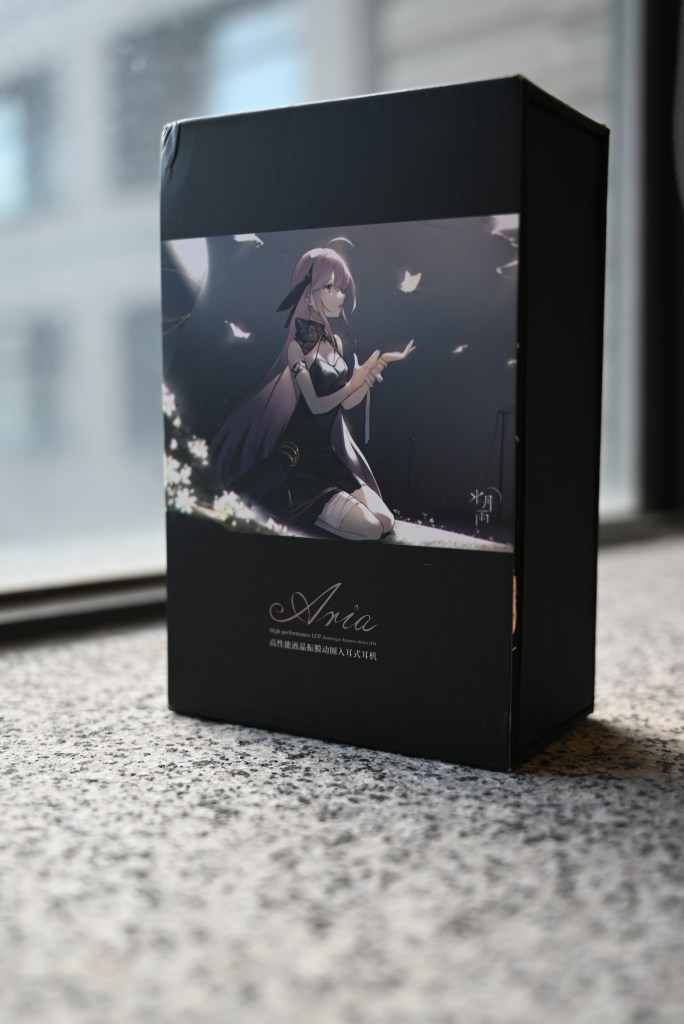
1. [Aria] earphone * 1
2. Nylon woven silver-plated cable * 1
3. Storage bag * 1
4. Tweezers * 1
5. Filters * 6
6. Silicon ear-tips * 3 pairs (S, M, L)
7. QC passed card * 1
8. Manual * 1
Setup

For this review, since I’m back in the US and with my reference components, I tested with them, and with some new goodies I’ve gotten from Taiwan as well, such as the Moondrop Moonriver2. The Moonriver 2 has 2 modes, a low gain mode and a high gain mode, of which I tested on both modes to ensure I get accurate impressions. The usual components from prior reviews include the Topping DX3 Pro in iem gain mode (-10db), and normal gain mode as well, to just be thorough. The Topping DX3 Pro is powered by the Topping accessory Linear Power Supply in this case, and playback includes my Samsung Galaxy Note20, of which has been replaced and traded for the S23 Ultra, and my desktop which has been upgraded before my hiatus from a work assignment in Taiwan, although that should not affect the sound since the playback means is mostly just data output to the Topping DX3 Pro, with the same cable and all, just a new tower.
As a little interesting side note, Moondrop makes this Dash75 keyboard of which I’ve bought, and included in the keyboard is the Moonriver2 module inside for the headphone dac/amp, of which I also use when playing back with the computer, of which I found no discernable difference with the standalone Moonriver2, but with no ability to switch the modes.
For the IEMs themselves, although the Aria does have the option to for the use of other cables and tips, I will use the included tips for the review for the out-of-the-box experience.
TLDR;
- Topping DX3 Pro (dac/amp) (2 modes)
- Moondrop Moonriver2 (dac/amp) (2 modes)
- And in the Moondrop Dash75 (just high gain mode)
- Samsung Galaxy S23 Ultra
- Samsung Galaxy Note20
- Custom PC
- Gaming PC, outputting just data to the DX3 and or the Moondrop Moonriver2
- Playback on Qobuz at CD quality or higher when available.
Build Impressions

It is very interesting to note, for this review, comparatively to other general earphones I have on hand, and in prior experiences, that for $80, this does not feel or weigh like one. Without knowing the price, I would have guessed this would punch above 3 digits at least. And for that this already has a good impression. From there, the 0.78mm pin connectors that can be disconnected is a huge plus, with this relatively standard IEM pin configuration. You can source different or replacement cables if they were to break, and serve as a longevity plus as well from that standpoint.
To touch on the technicals for the Moondrop Aria’s are equipped with, “10mm dual-cavity internal magnetic high-performance dynamic driver combines with the first generation DLC composite diaphragm”. This basically means a single driver in the IEMs, of which in my research and experience can have it’s drawbacks and advantages depending on preference and what you are looking for in an IEM experience. Others may have more than 1, but this model, only has 1 to product the full spectrum of sound. This driver seems to have Moondrop’s own improvements, from, say a more “typical” driver, so dubbed the LCP Liquid Crystal Diaphragm, which allows the Aria’s to produce the sound it has, as you will find out in the next section.
The Aria’s only come in one color for the headphones themselves, and are coated in a nice black outer with some elegant looking gold accents on the outer face of the IEMs. Also printed on the side is the model name Aria written in nice semi-cursive font, so let you know there are the Aria models since Moondrop actually reused the case shape and general outer design for some of their other models. Can’t really fault them for not differentiating the different models, however I can appreciate that at least in this cost-saving method, it’s a nice possible trickle down method for their design to keep on improving.

Included cables with the Aria’s is also pretty good quality, with metal on the 3.5mm jack coated in gold, and on the y-joint with the included clip to move the “y” point of the cables higher for convenience. It doesn’t tangle easily, and it has a nice fabric outter layer, which is nice to the touch and isn’t annoying when clothes or other items brush against the cables. The 0.78mm connectors are more plastic feeling, and more fragile, and with the design of the pin conection, which is tight for understandably many reasons, it was a little nervewrecking to plug them in, however when they are, you can be rest assured it won’t just disconnect or call off randonly whenever and whereever. This is a big plus, and as a relatively new IEM user, makes it very confidence inspiring that you can use them like normal earphones and swtich out the cables if you so want to, or if you need a replacement.
These are In-ear monitors so they actually sit in the ear canal a little more than normal “earphones”, although I don’t feel too much of a difference with my ears personally. Comfort-wise, these are super comfortable, with the cable going around the ear as part of the design. This relieves some weight from the ear canal itself, which increases comfort as I recall switching between my Sony XB50AP Extra Bass earphones, and if accidentally pulled, experienced much less pain and more ear folding. Personally I have not had too much experience with this design for earphones or in-ear monitors, so this was an increase in comfort compared to prior experiences with earphones. The included silicon tips are also comfortable and are easily capable for me to wear long-term, longer than 3-4 hours, which is what might be necessary if they were used as intended for the class audio reproduction these are for.
I will note that, I use them for more enjoyment purposes, as you might be able to tell from the whole website setup itself. And for that these are a superb option, providing great long-term comfort, although it is a learning experience with how you put these headphones on for some people who I’ve asked to try, and once you get it, it’s great to wear long-term and it’s quality is very nice for the price, metal enclosure, weight, and durability in my 1 year of owning these headphones until the time of writing. There has been some other users online that have reported paint chipping issues with the Aria, but personally I’ve observed none of that with my use case and how long I’ve used it, and have been happy with the state and quality of the product. One sturdy and simply great value option for someone looking to get into IEMs and audio.
Sound Impressions

Typically, IEMs are used to monitor audio in an audio production standpoint, however many also seem to use it because of this use point, arguing that this will get you sound that the sound engineers and mastering engineer intended for you to hear, and in essence, what you hear is what they want you to hear. It’s supposed to highlight details, mastering quality, and have a neutral sound to fit all the possible speaker setups and methods of replaying such song. This does not mean that you get something that you will enjoy listening to, as I’ve experienced beforehand. I may have expected something those lines when I was exploring my options and doing my purchases. But the Moondrop Aria seems to produce monitoring capabilities, and even listening enjoyment abilities, defying my expectations!
Although this is the first of IEMs I’m publishing reviews on, this isn’t my first time with one. I’ve started to collect a few from my time in Taiwan, and tested as many as I could in stores over there, exploring the interesting world of IEMs in asia. From there my collection grew, so I’ll be comparing them to what I have on hand, including my own collection and experience of speakers and etc. from my main reviews. Onwards then.
The Moondrop Aria exhibits a very impressive ability to perform. The soundstage is extends way beyond the IEMs, like I’m actually center stage. The stage itself sounds pretty wide and spacious, with great detail on everything that is playing through the Aria’s making the layers discernable and something you can look for if you so wish. This is also achieved with the pretty good instrument separation and accuracy, with instruments and layers of a song something you can pick out. Helping this soundstaging is also the good seal on the Aria’s which can ask as legitimate passive noise cancelling. Imaging is also very 3D, and for the Aria’s the center is pretty intimate. Comparatively to others like the Snow edition Arias, the Blessing 2 (both also from moondrop) and the Final E3000 that I compare to in general, the stage at center seems more intimate and in the middle of action than the others. This can be a slight drawback for some, although I find that this is fine, and for more intimate recordings with a center vocal, I don’t find it too forwards or intimate that it is uncomfortable. Just a little closer than others.
Although the Arias as an IEM is supposed to be pretty neutral for sound mastering, there are is still some character in it, which makes this like a generally neutral IEMS with a little coloring for some taste. From my own selection of speakers, this kind of character is my cup of tea. There is a realism yet smoothness from the Aria’s that can bring out the overdrive in an electric guitar and highlight smooth and airy vocals. And what I also appreciate in the Aria’s is the ability to induce the breath of vocals, which is something you’ll typically see on speakers of a higher bracket. This to me represents the good tuning and materials used, which at least to me makes the MSRP for the Aria’s seem like quite the value proposition for music enjoyment.
Speaking of enjoyment, although some may note that the frequency response as targeted and showed in the box is not neutral or one’s preference, I am also pleased to report that the Moondrop Aria is a very flexible IEM, with it responding well to equalizer tuning, and will retain similar quality as to what I report here, especially if that aspect remains relatively untouched in the tuning. The Aria’s are also scalable as I must mention, responding to the components it is paired with somewhat well, with higher priced options yielding generally better results up until a certain point. Both DX3 Pro and the Moondrop Moonriver2 both don’t change the character too much, however, they still can affect small details, so finding a synergistic pair can be part of the fun, although I generally found it quite excellent with Moondrop’s own Moonriver2.
In terms of the IEM world as far as I know, there are better performers out there, and to that I can agree. It’s not like this is perfect. From my collection and what I’ve heard at least, the sound stage could be more spacious and wider, the instrument separation could be more separate, and there is the possibility of more breath of vocals present that other products can product. One other slight criticism for the Aria’s that I have is that the bass is a little loose, which is also a charm in a way for me. I believe at least from the slightly loose bass, this brings about slightly more impact from the bass, however, I have heard products that can do it tighter and still bring the impact that this brings. The slight color as I mentioned from the character prior also includes a raised treble from what I’m more used to at least from my equipment experience, and this can make the Aria’s a little thin sometimes, comparatively to the Snow Edition and even the Final E3000 which is a slightly lower price bracket as well.
Despite that, the Aria’s for my first taste into IEMs at the time in my time in Asia brought upon my face, a smile and the passion to explore further the IEM world, one of which I appreciate about the overall package. Despite the flaws, there is a joy to listening with the Arias, as it also is not picky about its sources, which is a good thing from my experience in my speaker reviews, of which components can be picky about it, as I’m one to focus on listening enjoyment as well. Without the other references, from a daily driver perspective, the Aria’s are an IEM I could get used to and enjoy on a day to day basis, which is saying a lot coming from speakers, and especially for the price point of $80.
Conclusion
Moondrop has developed a very impressive package with the Aria’s producing a fun to listen, yet still pretty good technical IEM for multiple purposes and use cases. Although lacking in a few departments such as being slightly thin in sound, and a relatively loose bass character, this can be a charm for others, or something they would be able to tune out, which this will respond well to, and/or the weakness can be the charm as well. As is the case with the bass out of the box for me. This good looking, relatively weighty IEM exudes quality, and can be mistaken for a higher price point product from my perspective, which is great in overall value. Coming from speakers, this product paired with a good component can make me question my choices in going the speaker route. A product to audition as one of the considerations for IEMs to possibly start with!
Summary
Highlights
- Neutral IEMs with a little flair for many use cases
- Quality and weight that makes it seem like it costs more than MSRP
- Responds well to EQ tuning
- Comfortable long-term wearability
Possible improvements
- Tighter bass tuning
- less treble in mid-high range to sound less “thin”
Overall Rating: 4/5
- Sound Character: 4.5/5
- Accuracy: 4/5
- Comfort: 4/5
- Value: 4.5/5
- Affordability: 4.5/5
 HIFI Sound Enthusiast